Navigating a custody battle can be one of the most challenging experiences for any parent, especially fathers who may feel the system is against them. However, in Singapore, family courts prioritise the child’s welfare above all else, and fathers have equal legal rights when seeking custody.
Understanding how to get full custody of a child as a father requires preparation, evidence, and a clear, child-focused approach.
This guide breaks down the step-by-step process fathers can follow to build a strong custody case, avoid common mistakes, and confidently present themselves as capable, responsible caregivers in the eyes of the court.
How To Get Full Custody Of A Child As A Father?

For fathers in Singapore, seeking full custody can feel emotionally daunting and legally complex. However, understanding the right process and preparing your case thoroughly can make a real difference.
The goal is not to “win” against the other parent, but to show the court that you are the parent best positioned to provide a safe, stable, and supportive environment for your child. Below is a detailed guide on how to begin the custody process and strengthen your position in court.
Decide Whether To Seek Custody Within Divorce Proceedings Or By Separate Application
The first step in getting full custody as a father is identifying the correct legal route to take. Custody issues in Singapore are typically decided during divorce proceedings, but in certain situations, they can also be handled through a separate application.
Legally Married
If you are legally married and in the process of getting divorced, custody will automatically be addressed as part of your divorce case in the Family Justice Courts.
In this scenario, the court will expect both parents to submit a Parenting Plan, a document outlining how you each intend to care for and make decisions for your child.
This plan includes key details such as the child’s residence, schooling, healthcare, and contact arrangements with each parent. Fathers who can demonstrate that they’ve been actively involved in these areas and are prepared to continue providing consistent care are viewed favourably by the court.
Not Legally Married
If you are not married to the child’s mother or are already divorced, you may still apply for custody separately under the Guardianship of Infants Act (GIA).
This application is also made through the Family Justice Courts and is suitable for fathers who wish to formalise their parental rights or adjust an existing custody arrangement.
You will need to provide solid evidence showing that full custody serves your child’s best interests, such as stability in housing, schooling continuity, and emotional wellbeing.
In both cases, the court’s primary focus is the welfare of the child, not parental entitlement. Fathers should therefore concentrate on presenting a clear, factual case that proves they can meet their child’s physical, emotional, and educational needs better than any alternative arrangement.
Try To Reach An Agreed Arrangement First (And Prepare An Agreed Parenting Plan)
Before turning to the court for a decision, fathers are encouraged to try reaching an agreement with the other parent on custody and care matters. Courts in Singapore strongly favour amicable resolutions because these arrangements tend to be more stable and less stressful for the child.
An Agreed Parenting Plan is a formal document that sets out how both parents will handle key aspects of the child’s upbringing, including living arrangements, education, healthcare decisions, religious upbringing, and access schedules.
If both parents can agree on these terms, the court will typically endorse the plan, provided it serves the child’s welfare.
For fathers seeking full custody, this stage provides a valuable opportunity to show that they are cooperative and focused on the child’s needs.
Demonstrating a willingness to discuss, compromise, and act responsibly can significantly strengthen your image before the court. Even if full agreement isn’t possible, preparing a Proposed Parenting Plan that clearly outlines your caregiving role, time commitment, and stability can still work in your favour.
Expect Mediation / Family Dispute Resolution Early On

In Singapore, all custody disputes go through mandatory mediation and Family Dispute Resolution (FDR) before proceeding to a full hearing.
This process is designed to help parents find practical, less confrontational solutions that prioritise the child’s wellbeing. For fathers seeking full custody, understanding what to expect and preparing effectively can make mediation a powerful opportunity rather than a hurdle.
During mediation, a neutral court-appointed mediator or counsellor from the Family Justice Courts facilitates discussions between both parents. The goal is to reach common ground on issues such as custody, care, access, and financial support.
Unlike a court hearing, mediation is informal, confidential, and non-adversarial, it allows parents to discuss their concerns openly without having to “win” against each other.
To prepare effectively, fathers should:
- Review all key documents before attending — such as the proposed or agreed Parenting Plan, records of daily caregiving, and any prior arrangements or communications about the child.
- List out priorities — what is truly important for your child’s welfare (e.g. schooling, residence stability, healthcare decisions) and what you are willing to compromise on.
- Bring supporting evidence — messages, photos, school correspondence, or expense records that demonstrate your ongoing role as an involved parent.
- Adopt a calm and cooperative tone. Mediation is not about proving the other parent wrong, but about showing that you can act rationally and make decisions in your child’s best interests. Losing your temper or appearing inflexible can undermine your credibility later in court.
If both parents reach an agreement during mediation, the court can record it as a consent order, making it legally binding.
Even if full custody is not immediately granted, mediation may help secure substantial care and control arrangements in your favour, especially if you present yourself as a cooperative and solution-focused parent.
For cases that do not settle at this stage, the insights and documents exchanged during mediation can still support your custody case later. Thus, fathers should view FDR not just as a procedural step, but as an opportunity to demonstrate maturity, sincerity, and a genuine commitment to the child’s wellbeing.
Collect Documentary And Corroborating Evidence (This Is Crucial)
When it comes to custody decisions, evidence is everything. Courts in Singapore base their rulings on facts, not assumptions or emotions.
Fathers must be ready to prove that they are responsible, capable, and actively involved in their child’s daily life. Solid documentation can make the difference between a strong, credible case and one that appears unsupported or one-sided.
Start by gathering documentary evidence that shows consistent caregiving and financial stability. Examples include:
- School records – attendance reports, teacher feedback, parent–teacher meeting notes, and communications with school staff that show your involvement in your child’s education.
- Medical records – appointments you have attended, consent forms you’ve signed, and health-related correspondence.
- Financial statements – payslips, housing documents, or bank statements showing your ability to provide stable housing and meet your child’s needs.
- Proof of caregiving – photos, text messages, transport receipts, and activity logs showing your participation in daily routines such as school drop-offs, meals, or homework sessions.
- Character references – letters from teachers, neighbours, family friends, or caregivers who can attest to your parenting involvement and reliability.
Consider An Independent Custody Evaluation (When Appropriate)
In some cases, the Family Justice Courts may order a custody evaluation to gain a clearer understanding of the family situation before making a decision.
This evaluation is typically conducted by trained professionals, such as counsellors or social workers from the Ministry of Social and Family Development (MSF), or other court-appointed experts. For fathers seeking full custody, it is important to understand what this process involves and how to prepare for it effectively.
A custody evaluation is a comprehensive assessment of each parent’s ability to meet the child’s physical, emotional, and psychological needs. It may include interviews with both parents, observations of parent–child interactions, and sometimes home visits to assess living arrangements.
The evaluator will consider several factors, the child’s attachment to each parent, emotional stability, caregiving history, and each parent’s capacity to support the child’s development.
Fathers should approach this process with openness and honesty. Evaluators are trained to look beyond rehearsed statements; they focus on consistency between what you say and how you behave.
During interviews, speak calmly and sincerely about your parenting approach, your child’s needs, and how you plan to ensure their stability and happiness. Avoid criticising the other parent excessively, instead, highlight your strengths, daily routines, and the positive bond you share with your child.
If a home visit is scheduled, ensure that your living environment is safe, tidy, and child-friendly. This does not mean it has to be perfect, but it should reflect a stable and nurturing space where your child can live and thrive.
Have your child’s belongings, such as books, clothes, or toys, visibly placed to show that you have thoughtfully prepared for their care.
The evaluator may also speak with the child privately, especially if they are old enough to express their views.
Do not coach your child on what to say, evaluators can easily detect this, and it can damage your credibility. Instead, focus on maintaining a positive relationship with your child, showing genuine affection and stability.
After completing the assessment, the evaluator will submit a report to the court with recommendations. While these findings are not legally binding, they carry significant weight in custody decisions.
A favourable evaluation can strongly support your application for full custody, as it provides an independent professional’s view that your parenting arrangement is in the child’s best interests.
Being cooperative, transparent, and respectful throughout the process will reflect well on you. Remember: the evaluation is not a test to “pass”, but an opportunity to demonstrate that you are a responsible, caring, and capable father who prioritises your child’s welfare above all else.
Get Legal Advice And Representation (Or Apply For Legal Aid)

Navigating Singapore’s family court system can be challenging, especially for fathers unfamiliar with legal procedures.
Engaging a family lawyer is one of the most practical steps you can take when pursuing full custody. A qualified lawyer can guide you through each stage, from preparing your Parenting Plan and submitting evidence, to representing your interests in mediation and court hearings.
An experienced family law practitioner can also help you understand your rights under the Women’s Charter and the Guardianship of Infants Act (GIA). They can assess your situation objectively and provide a realistic picture of your chances for full custody based on your current caregiving role and available evidence.
Moreover, having legal representation ensures that you comply with court timelines, submit documents correctly, and avoid procedural errors that could delay or weaken your case.
If you have limited financial means, you may be eligible for assistance under the Legal Aid Bureau (LAB), which provides subsidised or free legal services for Singapore citizens and permanent residents who meet the income criteria.
Legal Aid covers family law matters such as divorce, maintenance, and custody applications. You can apply directly through the LAB website or visit their office for guidance.
When applying, be prepared to provide documents like income statements, CPF contribution history, and details of your case.
For fathers who prefer some professional help but cannot afford full representation, consulting a lawyer for a few hours of legal advice can still be valuable.
Many family lawyers in Singapore offer initial consultations where you can clarify your options, understand your rights, and receive tailored guidance on the best strategy to adopt.
File The Correct Court Documents And Evidence Bundle
Once you’ve prepared your case and gathered supporting evidence, the next crucial step is to file the correct documents with the Family Justice Courts. Accuracy and organisation are essential, incomplete or late submissions can delay your case or even weaken your application for full custody.
The main document you will need is an Originating Summons or Summons for Custody, depending on your situation. If your custody application forms part of divorce proceedings, it will be included as part of your divorce documents.
For standalone custody applications under the Guardianship of Infants Act (GIA), you must file a separate Summons in the Family Courts.
Along with your application, you’ll need to file an Affidavit of Evidence-in-Chief (AEIC). This sworn statement outlines your parenting history, caregiving role, financial stability, and the reasons you believe full custody serves your child’s best interests.
This is your opportunity to present a structured, factual overview of your involvement in your child’s life. Avoid emotional or accusatory language; the court prefers clear, well-documented evidence supported by exhibits.
Your evidence bundle should include:
- Parenting Plan (agreed or proposed) detailing care arrangements, schooling, and decision-making responsibilities.
- Documentary proof such as school reports, medical records, and communication logs showing your caregiving role.
- Financial documents demonstrating stability and ability to support your child (e.g. payslips, CPF statements, tenancy agreements).
- Character references from teachers, relatives, or caregivers.
- Any relevant reports from counsellors, mediators, or social workers.
Each exhibit must be clearly labelled and referenced in your affidavit. For instance, use “Exhibit A” for school records or “Exhibit B” for medical receipts.
Prepare For Hearings: Present The Child-Centred Case Calmly And Factually
Court hearings can be emotionally charged, especially when your relationship with your child is at stake. However, your demeanour and conduct during proceedings can significantly influence how the court perceives you.
Fathers who remain calm, respectful, and focused on their child’s welfare often leave a stronger impression than those who appear defensive or confrontational.
Here are some practical tips to help you prepare effectively:
- Know your documents thoroughly. Be familiar with every piece of evidence in your affidavit and exhibits. If the judge refers to a specific document, you should be able to locate and discuss it confidently.
- Dress appropriately. A clean, professional appearance shows respect for the court and reflects your seriousness about the matter.
- Arrive early. Punctuality demonstrates responsibility and composure.
- Address the judge properly. Say “Your Honour” when speaking, and always stand when addressing the court.
- Listen carefully before responding. Take a moment to think before answering, especially if a question feels challenging. Avoid interrupting.
- Maintain a calm tone. Even if you feel provoked or misrepresented, stay composed. Losing your temper or raising your voice can harm your credibility and suggest poor emotional control, traits the court considers in custody matters.
- Show your commitment to co-parenting. The court often looks favourably upon parents who demonstrate cooperation and maturity. Emphasise that your focus is on your child’s well-being, not personal conflict.
If The Order Is Not What You Want: Grounds For Appeal And Review

Singapore’s legal system provides fathers with options to appeal a decision or apply for a variation later on, particularly if new circumstances arise.
- Appealing a Custody Order
If you believe the court made an error in assessing your case, you may file an appeal to the Family Division of the High Court. This must be done within 14 days from the date the order was issued, so time is of the essence.
An appeal is not a chance to present your case from scratch; rather, it is a review of whether the original decision was legally or procedurally flawed.
You must demonstrate that the court:
- Made a mistake in applying the law, or
- Relied on irrelevant or insufficient evidence, or
- Overlooked key facts that could have influenced the decision.
Before filing an appeal, seek legal advice from a family lawyer to assess the strength of your case. They can review the judge’s written grounds of decision and identify viable points for appeal.
- Applying for a Variation of Custody Order
Even after a custody order has been finalised, it can be reviewed or varied if there has been a material change in circumstances affecting the child’s welfare. This is different from an appeal; instead of challenging the original decision, you’re asking the court to reconsider custody in light of new developments.
For example, you may apply for a variation if:
- The other parent’s behaviour or living situation has become unstable or unsafe.
- You have significantly improved your own circumstances, for instance, securing stable housing, employment, or support systems.
- The child’s needs have changed due to age, health, or schooling.
- There is evidence that the current arrangement is causing emotional or academic harm.
To apply, you’ll need to submit a Summons to Vary Custody Order to the Family Justice Courts, along with an affidavit explaining the changes and attaching supporting documents.
9 Practical Checklist (Documents To Prepare Now)

When preparing for a custody application, having the right documents ready can make a significant difference. Courts in Singapore rely heavily on clear, verifiable evidence to assess your parenting involvement, financial stability, and overall ability to provide a secure home for your child.
The checklist below outlines essential documents every father should compile before or during custody proceedings to ensure nothing important is overlooked.
- Child’s birth certificate, school and medical records.
- Parenting Plan (draft): daily care, residence, schooling, holiday schedule, decision-making.
- Evidence of day-to-day parenting: dated messages, photos, receipts, school notes.
- Proof of stable housing and finances (tenancy, payslips).
- Character references (signed, dated).
- Police/medical reports if safety concerns exist (only if supported by records).
- Any prior court orders, CPS/MSF reports, counselling records.
- Contact details for witnesses (teachers, caregivers).
- Legal Aid application (if you need help).
5 Common Mistakes Fathers Make When Fighting For Child Custody

Understanding common pitfalls can help fathers stay composed, credible, and focused on what truly matters: showing the court that they are capable, responsible, and committed to their child’s best interests.
Below are five common mistakes fathers make during custody proceedings, along with practical guidance on how to avoid them.
1. Attacking the Mother Instead of Proving Good Parenting
Don’t turn the dispute into a personal attack. Courts prioritize the child’s best interests, not parental conflict.
- Mistake: Constantly highlighting the mother’s faults; this makes you appear bitter and uncooperative.
- Correction: Focus on demonstrating your positive caregiving with clear, factual evidence (e.g., school meeting attendance, medical management, homework help). Use a respectful tone and propose solutions based on the child’s needs, not your disagreements.
2. Failing to Document Daily Involvement
Verbal claims of being an involved father aren’t enough; the court requires tangible proof.
- Mistake: Not keeping proper records of your daily role in your child’s life.
- Correction: Keep a detailed parenting log and collect evidence of your consistent activity:
- Photos/Videos of shared activities.
- Messages with teachers or doctors.
- Receipts for school fees and medical expenses you covered.
- Organize and clearly label all documentation to show a pattern of consistent care.
3. Displaying Anger or Poor Conduct During Proceedings
Emotional composure is a key indicator of your ability to provide a stable home.
- Mistake: Losing your temper, interrupting, or speaking disrespectfully (even through non-verbal cues like eye-rolling). This severely harms your credibility.
- Correction: Maintain a calm, measured, and respectful approach throughout all hearings and communications. Your composed behavior demonstrates that you can handle stress and disagreements constructively, a vital trait for a custodial parent.
4. Ignoring Legal Procedures and Deadlines
The process involves formal steps necessary for fairness; non-compliance suggests you aren’t taking the case seriously.
- Mistake: Missing filing deadlines, submitting incomplete affidavits, or failing to attend mandatory sessions. This leads to delays and can result in adverse rulings.
- Correction: Keep a clear timeline of all dates and tasks. Use legal counsel to ensure all documents are correctly prepared and submitted on time. Staying organized shows the court you are a responsible and conscientious parent.
5. Not Prioritising the Child’s Stability and Best Interests
The court’s sole focus is the child’s welfare, not the parents’ rights.
- Mistake: Focusing too heavily on your own rights or using the case to punish the other parent.
- Correction: Anchor your case in a child-centred plan. Highlight practical examples of how your arrangement benefits the child’s stability: how your schedule ensures consistent care, how your home supports their routine, and your willingness to encourage a relationship with the other parent (barring safety concerns). This approach is most likely to secure favourable custody terms.
Conclusion About Getting A Full Custody Of A Child As A Father
Securing full custody as a father in Singapore is not about winning a battle, it’s about showing the court that your child’s well-being comes first.
Understanding how to get full custody of a child as a father means being prepared, staying composed, and presenting clear evidence that you can provide a safe, stable, and nurturing environment.
Courts value fathers who demonstrate responsibility, emotional maturity, and genuine commitment to their children’s growth.
If you require professional support to strengthen your case, contact CatchCheating, Singapore’s Top Private Investigators. Our licensed and highly experienced team provides discreet, reliable evidence through expert surveillance and investigative techniques.
Whether you’re gathering proof for family and matrimonial matters, child custody investigations, commercial disputes, or local and overseas investigations, our agency is fully certified by the Police Licensing & Regulatory Department (PLRD) and backed by over 30 years of experience.
Take the next step with confidence, contact CatchCheating today to secure the evidence you need for your custody case or personal peace of mind.
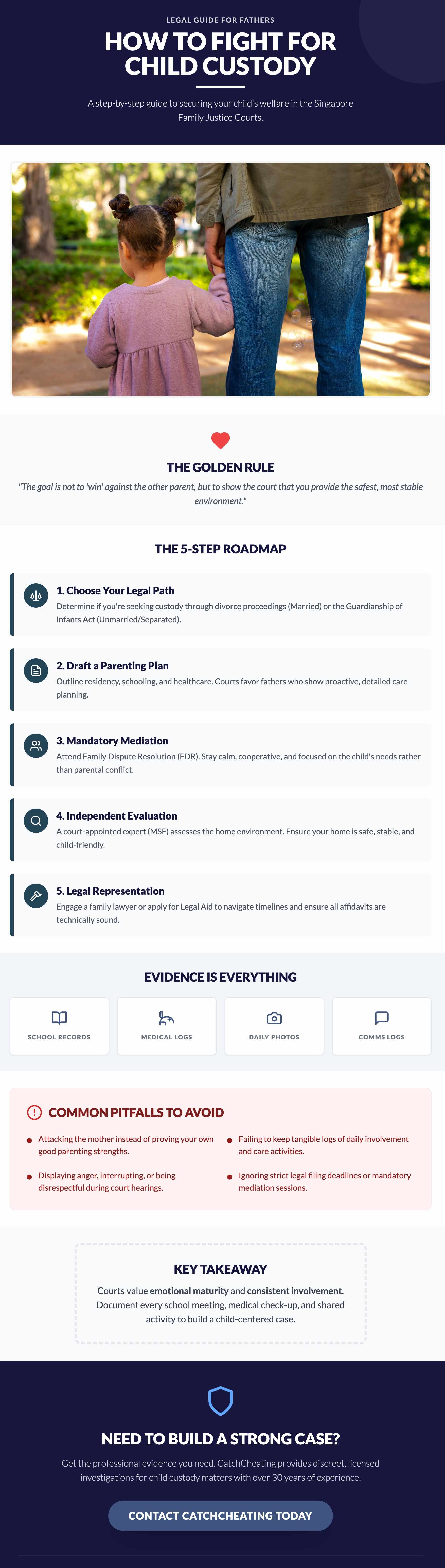
Frequently Asked Questions About Getting A Full Custody Of A Child As A Father
Does A Father Have The Same Custody Rights As A Mother In Singapore?
Yes. Under Singapore law, both parents have equal rights and responsibilities. The court bases its decision on the child’s welfare, not the parent’s gender.
Are Fathers At A Disadvantage When Seeking Full Custody?
Not necessarily. Fathers who can demonstrate consistent involvement, emotional stability, and a safe environment stand an equal chance of being granted custody.
Is Full Custody Permanent Once Granted To A Father?
No. Custody orders can be changed if circumstances significantly shift, for example, if the child’s welfare is at risk or a parent becomes unfit to care for the child.
Can A Father Get Full Custody If The Mother Disagrees?
Yes, but he must present strong evidence showing that sole custody serves the child’s best interests, such as proof of neglect, instability, or a harmful environment.
Where Should A Father File For Full Custody In Singapore?
Custody applications are filed in the Family Justice Courts of Singapore. Fathers should prepare a detailed Parenting Plan and submit all supporting evidence with their application.
When Can A Father Apply For A Change In Custody Order?
A father may apply for a variation when there’s a material change in circumstances, such as relocation, remarriage, neglect, or changes affecting the child’s welfare or schooling.
Should A Father Move Out Of The Family Home During Custody Proceedings?
If possible, no. Remaining in the child’s primary home can strengthen a father’s case for stability and caregiving consistency. Moving out may weaken claims of daily involvement.
Do Singapore Courts Consider The Child’s Wishes In Custody Cases?
Yes. For older or more mature children, the court may consider their preferences, but the final decision always depends on what best supports the child’s welfare.