Fighting for child custody can be one of the most emotional and challenging experiences a mother faces. Understanding how to get full custody of a child as a mother in Singapore requires careful preparation, legal knowledge, and a clear focus on your child’s welfare.
This guide will walk you through each step of the process, from understanding the legal framework to preparing evidence and presenting your case in court.
By knowing your rights and responsibilities, you can make informed decisions and build a strong case that shows the court you are acting in your child’s best interests.
Step-By-Step Process On How To Get Full Custody Of A Child As A Mother

Seeking full custody of your child in Singapore can be an emotionally demanding and complex process. This section breaks down what mothers need to know, from understanding the legal framework to exploring peaceful resolution methods, before taking their case to court.
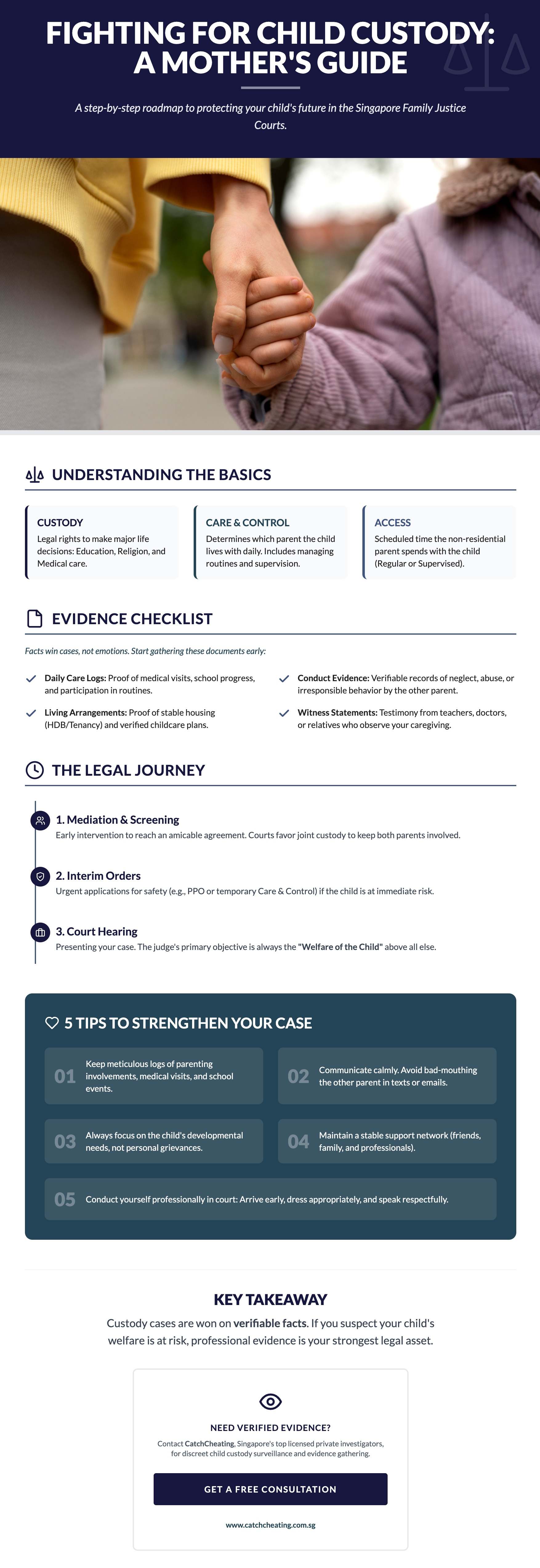
Understand The Legal Framework And What “Full Custody” Means
In Singapore, custody issues are governed mainly by the Women’s Charter and the Guardianship of Infants Act. These laws make it clear that the child’s welfare is always the court’s top priority.
- Custody – This gives a parent the right to make major decisions about the child’s upbringing, such as education, religion, and medical care. Custody can be sole (granted to one parent) or joint (shared between both parents).
- Care and Control – This determines which parent the child lives with on a daily basis. The parent with care and control is responsible for daily routines, discipline, and supervision.
- Access – This refers to the time the non-residential parent (the one without care and control) is allowed to spend with the child. Access can be scheduled (specific days and times) or liberal (flexible, by agreement).
When people talk about “full custody”, they usually mean having sole custody and care and control, with the other parent having limited or supervised access. However, Singapore courts generally prefer joint custody, as it encourages both parents to remain involved in their child’s life.
Sole custody is typically granted only when the other parent is proven to be unfit, abusive, neglectful, or completely absent from the child’s life.
Consider Non-Court Options First (Mediation / Family Guidance)
Before turning to the courts, Singapore strongly encourages parents to explore non-court solutions like mediation and family guidance. These approaches are designed to help parents reach mutually acceptable arrangements without the stress, expense, and hostility of litigation.
Mediation
Mediation is conducted by trained professionals, often at the Family Justice Courts or at community-based agencies such as the Ministry of Social and Family Development (MSF).
During mediation, both parents are encouraged to discuss practical arrangements for their child in a safe and neutral setting. The mediator helps both sides find common ground and focus on the child’s needs, not personal grievances.
If both parents can agree, the mediator may draft a consent order, which formalises the arrangement legally once approved by the court. This outcome is faster, less costly, and often less emotionally draining than a contested hearing.
Family Guidance
Another early option is the Family Guidance Order (FGO) process, which involves counselling and guidance sessions with social service agencies.
These sessions help parents improve communication and co-parenting, especially in high-conflict situations. Family service centres such as Singapore Children’s Society, Epworth Community Services, or Thye Hua Kwan Family Service Centre often facilitate these sessions.
Choosing mediation or family guidance first doesn’t mean you’re giving up your rights as a mother. On the contrary, it demonstrates to the court that you are cooperative, reasonable, and focused on your child’s welfare, qualities judges look upon favourably.
Decide What Orders You Need And Whether To Apply Under Guardianship / Family Proceedings

Before filing any custody application, it’s important to understand what kind of order you actually need. The Family Justice Courts in Singapore handle different types of applications depending on the circumstances, and knowing which one applies to your case can save you time, money, and unnecessary stress.
There are three main types of family-related orders that mothers can apply for:
- Custody Orders: These deal with major decision-making rights over the child. A custody order determines who decides on significant matters such as education, medical treatment, religion, and overall upbringing.
- Sole custody gives one parent full authority to make these decisions.
- Joint custody allows both parents to share decision-making responsibilities.
- Care and Control Orders: Care and control determine which parent the child lives with daily. The parent granted care and control is responsible for the child’s day-to-day needs, discipline, and emotional well-being. The other parent usually receives access rights, which specify when and how often they can spend time with the child.
- Guardianship Orders: Guardianship goes beyond physical care, it gives a person legal authority and responsibility for the child. Mothers usually apply for guardianship when the father is absent, deceased, or unfit, or when they need to formalise their sole caregiving role. Guardianship applications are made under the Guardianship of Infants Act.
Get Your Evidence And Paperwork In Order
As a mother, presenting clear, organised, and honest evidence shows that you’re serious about your role as a caregiver and that your case is based on facts, not emotion.
Here’s what you should prepare before filing your application:
1. Basic Documents
- Child’s birth certificate
- Parents’ marriage certificate or divorce papers (if applicable)
- NRIC or passport copies for identification
- Proof of residence such as utility bills or tenancy agreements
- Income documents like payslips, CPF contribution statements, or employment letters
These provide the court with a clear picture of your identity, relationship to the child, and financial stability.
2. Evidence of Daily Care and Parental Involvement
- School attendance and progress reports
- Medical records or vaccination documents
- Photographs showing family routines or activities
- Communication logs (messages or emails) that show your caregiving involvement
- Testimonies or statements from teachers, neighbours, or relatives who can vouch for your role
Such evidence demonstrates that you are the child’s main caregiver and can provide a stable, nurturing environment.
3. Proof of the Other Parent’s Conduct (If Relevant)
- Police reports, medical reports, or counselling records (in cases of violence, abuse, or neglect)
- Screenshots or written records showing harmful or irresponsible behaviour
- Social service or counselling reports, if the family has been under supervision
Only include evidence that is factual and verifiable. Avoid exaggerating or making unsupported claims, as the court will cross-check all submissions carefully.
4. Supporting Documents for Living Arrangements
- Proof of stable housing (rental agreement, HDB ownership, or tenancy documents)
- Information on childcare arrangements, if you work full-time
- Letters of support from family members who assist with caregiving
These details show the court that your child’s daily needs, such as housing, care, and supervision, are consistently met.
File The Application At The Family Justice Courts (What To Expect)
Once you’ve gathered your evidence and decided which orders to apply for, the next step is to file your application at the Family Justice Courts (FJC). This is where the legal process officially begins. Filing correctly ensures your case is heard promptly and avoids unnecessary delays.
Here’s how the process typically works:
1. Preparing Your Application: You’ll need to prepare and submit the relevant court documents. These usually include:
- Originating Summons – the main document that starts your custody application.
- Supporting Affidavit – your written statement outlining the facts of the case, your relationship with the child, and why full custody is in the child’s best interests.
- Annexed Documents – these are the supporting materials you’ve already gathered (e.g. birth certificates, school reports, photos, witness statements, etc.).
If you’re represented by a lawyer, they will draft and file these documents for you. If you’re filing on your own, you can visit the FJC’s counters at Havelock Square or use the eLitigation system through a law firm or an authorised service bureau.
2. Paying the Filing Fees: Filing fees vary depending on the type of application, but generally, expect to pay between $50 and $250. You’ll receive an official receipt once the documents are submitted. If you face financial hardship, you may apply for a fee waiver or legal aid through the Legal Aid Bureau.
3. After Submission: Once your documents are filed, the court will issue a case number and fix a date for your first mention or case conference. This is not the hearing yet, it’s an administrative session to review your application and determine what should happen next.
You must also serve the application on the other parent (the Respondent). This means giving them an official copy of your documents so they are aware of the case and can respond. Service must be done correctly, typically by a process server or through registered mail.
4. What Happens Next: After filing, the court will usually direct both parties to attend mediation or counselling before a full hearing is set. This gives both parents a chance to resolve matters amicably, especially if the case involves children.
Prepare For Pre-Hearing Procedures (Mediation, Case Conferences, Agency Screening)

Before your custody case reaches a full hearing, you’ll go through several pre-hearing steps. These are designed to help parents reach an agreement and reduce the emotional and financial toll of a contested trial.
Here’s what to expect:
- Mediation: The Family Justice Courts strongly encourage mediation before any trial begins. Mediation is a confidential process led by a neutral mediator who helps both parents discuss issues openly and explore solutions together.
The aim is to reach a mutual agreement that protects the child’s welfare without prolonged court battles. Many cases in Singapore are resolved at this stage because mediation allows parents to make decisions together instead of leaving them entirely to the judge. - Case Conferences: If mediation doesn’t lead to an agreement, the court will hold case conferences to manage the next steps. These are short meetings before a judge or registrar to:
- Review the status of your case
- Identify issues that remain unresolved
- Set timelines for filing affidavits and evidence
- Schedule hearing dates
- Agency Screening and Counselling: For certain cases, especially those involving conflict, allegations of neglect, or safety concerns, the court may refer both parents to the Family Support Division (FSD) or Social Service Agencies (SSAs) for assessments.
These agencies may:- Conduct home visits to evaluate living conditions
- Speak with both parents and the child to assess relationships
- Provide parenting plans or counselling reports to assist the court in making decisions
- How to Prepare for Pre-Hearing Procedures
- Be punctual and attend all scheduled sessions.
- Bring necessary documents and copies for reference.
- Keep communication respectful and child-centred.
- Follow any directions given by the judge or agency officers.
Apply For Interim (Temporary) Orders If Urgent
In some situations, waiting for the full custody process to conclude may not be possible, especially if your child’s safety or well-being is at immediate risk.
When Interim Orders May Be Needed
You can request interim custody or care and control if there are urgent concerns such as:
- Domestic violence or abuse — where the child or mother faces physical or emotional harm.
- Neglect or unsafe living conditions — for instance, if the other parent leaves the child unattended or in dangerous environments.
- Disruption to schooling or daily routines — where the child’s stability is at risk due to ongoing disputes.
- Abduction risk — if you fear the other parent may take the child overseas without consent.
How to Apply for Interim Orders
- Prepare an Urgent Application: File a Summons for Interim Custody, Care and Control together with a Supporting Affidavit that explains why immediate intervention is necessary. Include clear evidence, such as:
- Police or medical reports (if abuse is alleged)
- Photographs or witness statements
- Messages, emails, or call logs showing threats or erratic behaviour
- Request a Protection Order (if applicable): If there is violence or the threat of violence, you can also apply for a Personal Protection Order (PPO) or Expedited Order (EO) under the Women’s Charter. These orders prohibit the abuser from committing further acts of violence and can be granted on the same day if the threat is urgent.
- What Happens After Filing: The court may call for an urgent mention, a short session where the judge hears both sides before deciding if the temporary order should be granted. In especially serious situations, the court may even issue an ex parte order, meaning it can be granted without notifying the other party first (to prevent further harm).
- Duration of Interim Orders: Interim orders remain in force until the final custody hearing or until the court decides they are no longer necessary. During this period, both parents must strictly comply with the terms set.
Court Hearing And How To Present Your Case
When your custody application proceeds to a hearing, preparation and presentation matter just as much as your evidence. The court hearing is where you’ll have the opportunity to explain your case in full, and show why granting you full custody serves your child’s best interests.
- Understand What the Court Looks For
The Family Justice Courts prioritise the child’s welfare above all else. Judges consider several key factors, including:
- Who has been the main caregiver
- The emotional bond between each parent and the child
- The child’s living conditions and stability
- Each parent’s ability to cooperate on decisions
- Any history of violence, neglect, or irresponsible behaviour
- Organise Your Evidence Clearly
Make sure all your documents and exhibits are neatly organised and easy to follow. Arrange them in logical order, for example, by date or by category (education, medical, communication, etc.).
- Label key documents for quick reference.
- Prepare short summaries of important points.
- Avoid overwhelming the court with unnecessary information.
- How to Present Yourself in Court
Your demeanour in court matters. Judges pay attention not only to what you say, but how you conduct yourself.
- Dress appropriately and arrive on time.
- Speak politely, address the judge as “Your Honour”, and wait for your turn to speak.
- Stay composed even if the other parent or their lawyer says something upsetting.
- Avoid arguing or interrupting; instead, make your points calmly and clearly.
- Focus on the Child’s Best Interests
When making your case, always centre your arguments on what benefits your child, not on personal grievances. For example:
- Instead of saying, “My ex is irresponsible,” say, “I’ve been the one ensuring our child attends school and receives medical care consistently.”
- Show how your arrangement supports the child’s emotional, educational, and developmental needs.
Judges appreciate parents who remain child-focused and constructive.
- Possible Outcomes After the Hearing
After hearing both sides, the court may:
- Grant sole custody (to one parent) or joint custody (shared decision-making)
- Assign care and control to one parent
- Set access rights for the other parent
- Impose supervised access if there are safety concerns
If you disagree with the outcome, you may apply to vary (change) the order or appeal within a specified timeframe, usually within 14 days of the decision.
Possible Outcomes And What “Full Custody” Might Look Like

After the court has reviewed all evidence, heard both parties, and considered the child’s best interests, it will issue a custody order. It’s important for mothers to understand that “full custody” can take several forms and does not always mean the complete exclusion of the other parent.
- Sole Custody
In a sole custody arrangement, the mother has exclusive decision-making authority over major aspects of the child’s life. This includes:
- Education (which school the child attends)
- Religion (what faith or moral instruction the child receives)
- Healthcare (consent for medical treatment)
- General upbringing and welfare
The father, in this case, does not have legal rights to make these decisions, although the court may still grant him access rights to maintain contact with the child.
- Joint Custody with Sole Care and Control
In many cases, Singapore courts favour joint custody, as it encourages both parents to remain involved in their child’s life. However, the court may also give care and control to one parent (often the mother), meaning the child will live with her on a day-to-day basis.
Under this arrangement:
- The mother handles the child’s daily needs, routines, and supervision.
- Both parents must agree on major decisions.
- The non-custodial parent typically has regular access (visitation).
- Shared Care and Control
In rare cases, the court may order shared care and control, allowing the child to spend significant time living with each parent.
This is usually granted only if both parents live close to each other, have good communication, and can cooperate effectively. It’s less common due to the potential disruption it may cause to the child’s routine.
- Access Rights for the Other Parent
Even if a mother is granted full custody and care and control, the other parent usually retains access rights, unless the court finds such contact harmful. Access can be:
- Fixed access (specific days or hours)
- Liberal access (flexible, as agreed between parents)
- Supervised access (monitored by a social worker or family member, in cases involving safety concerns)
- What “Full Custody” Means in Practice
When people refer to “full custody,” they often mean a combination of sole custody (decision-making power) and care and control (day-to-day care).
However, even with full custody, the mother must still honour access arrangements set by the court and act in the child’s best interests at all times. Breaching orders or restricting access without valid reasons can lead to legal consequences.
Enforcement, Variation, And Appeals
Once a custody order has been granted, both parents are legally bound to follow its terms. But what happens if one parent breaches the order, or circumstances change significantly after the decision? Singapore law provides clear pathways for enforcement, variation, and appeals.
- Enforcement of Custody Orders
If the other parent fails to comply with the court order, for example, by refusing to return the child after access, denying agreed visitation, or interfering with your custody rights, you can apply to enforce the order.
Here’s what you can do:
- File a Summons for Enforcement at the Family Justice Courts.
- Attach evidence of the breach, such as messages, witness accounts, or police reports.
- The court may issue a warning, fine, or in serious cases, committal proceedings (which could lead to imprisonment).
- Variation (Changing the Custody Order)
Life circumstances can change, for example, a parent may relocate, remarry, face health issues, or experience changes in financial stability. In such situations, you can apply to vary (amend) the existing custody or access order.
To apply for variation, you must show the court that there has been a material change in circumstances since the last order. Examples include:
- The other parent consistently breaches access or custody arrangements.
- The child’s needs have changed (e.g. school transitions, special care requirements).
- Evidence of neglect, abuse, or unsafe conditions emerges.
- Appeals
If you strongly disagree with the court’s decision, you may file an appeal to the High Court within 14 days from the date of the order. Appeals are not re-trials; instead, they review whether the Family Justice Courts made a legal or factual error in reaching its decision.
An appeal should be considered carefully, ideally with legal advice. You’ll need to submit grounds of appeal and supporting documents explaining why you believe the decision should be changed.
- Staying Compliant and Cooperative
Even after obtaining full custody, it’s important to maintain open communication (where safe) and comply with all court directions. Courts appreciate parents who remain cooperative and child-focused, even post-judgment.
Practical Checklist (What To Do Next, Quick Action List)

When emotions run high and the legal process feels overwhelming, it helps to have a clear action plan. This checklist provides immediate, practical steps you can take to strengthen your custody case and protect your child’s well-being.
Document
Good documentation is one of the strongest forms of evidence in any custody case. Start keeping detailed records as early as possible, even before filing your application. This shows the court that you are a responsible, attentive parent who takes your child’s welfare seriously.
Here’s what you should record and organise:
- Daily routines and caregiving
- Educational progress
- Medical and health matters
- Communication logs
- Incidents or disputes
Keep both physical and digital copies of important documents. Label and store them securely, cloud storage, USB drives, or dedicated folders work well.
Safety First
Your child’s safety, and your own, should always come first. If you ever feel that your child is in immediate danger, act without delay. The law in Singapore provides several protective options to help you safeguard both of you while the custody process is ongoing.
Here’s what you can do:
- Apply for a Personal Protection Order (PPO): This order legally prohibits the abusive parent from committing acts of violence or harassment. You can also request an Expedited Order (EO) if the threat is urgent. Both can be applied for at the Family Justice Courts.
- Request Interim Custody or Care and Control Orders: If you fear for your child’s immediate welfare, you may apply for interim (temporary) orders to ensure that your child stays in your safe care until a final decision is made.
- Contact the Police or Seek Shelter: In serious cases of violence or abuse, don’t hesitate to call the police. You can also contact Family Service Centres (FSCs) or crisis shelters in Singapore for emergency housing and counselling.
- Speak to a Family Lawyer or Counsellor: Legal professionals and social workers can guide you through protective applications and safety planning.
Pre-FGO Screening
Before a custody application proceeds to full litigation, parents are often required to go through Pre-Family Guidance Order (Pre-FGO) screening or mediation. These are early intervention steps designed to help families resolve disputes amicably, without escalating to a court trial.
What Pre-FGO Screening Involves:
- Conducted by the Ministry of Social and Family Development (MSF) or designated Family Service Centres (FSCs).
- A trained counsellor or social worker meets both parents to assess the family’s situation and explore possible solutions.
- The focus is on communication, cooperation, and the child’s welfare, not on assigning blame.
Why It’s Beneficial:
- It helps parents reach agreements faster and with less emotional strain.
- It demonstrates to the court that you are open to cooperation and focused on your child’s needs, not personal conflict.
- It often results in more flexible, practical arrangements than what a judge might impose.
File

Once you’ve gathered all your evidence and organised your documents, the next step is to file your application at the Family Justice Courts. This is a crucial stage, accuracy, completeness, and clarity matter greatly, as any errors or missing documents can cause delays or even weaken your case.
Here’s what you’ll typically need to file:
- Originating Summons (OS): This form officially begins your custody application. It sets out the orders you’re seeking, such as full custody, care and control, or access.
- Supporting Affidavit: This is your written statement detailing why you’re applying for custody and how your proposed arrangement serves your child’s best interests. Include factual information, supported by evidence (like documents or photos).
- Statement of Particulars: In some cases, you may also need to submit additional details about the family background, living arrangements, and current caregiving responsibilities.
- Annexed Documents: Attach relevant records such as school reports, medical documents, communication logs, and proof of financial stability.
Once filed, you’ll receive a case number and hearing date. Filing can be done online through the eLitigation system, but you may also seek help from the LawNet Service Bureau if you’re unsure how to proceed.
Legal Help
Custody cases can be legally complex and emotionally draining, so it’s always wise to seek qualified legal advice. Engaging a family lawyer helps you navigate the system, interpret court orders, and understand how to frame your case in the best possible way.
A family lawyer can:
- Explain your rights and obligations as a parent under Singapore law.
- Help draft your affidavit and ensure your documents are presented in the correct legal format.
- Advise you on the type of custody order to pursue based on your situation.
- Represent you in mediation and court hearings to advocate for your child’s welfare.
- Identify potential weaknesses in your case and guide you on how to strengthen them with evidence.
If hiring a private lawyer is financially challenging, you can explore Legal Aid through the Legal Aid Bureau (LAB), which provides affordable legal assistance to Singapore citizens who meet the means test.
Support
Start by leaning on your trusted network, family, close friends, or mentors who can offer emotional stability and practical help, like childcare or transportation. Beyond personal support, there are also professional and community resources available in Singapore:
- Family Service Centres (FSCs): Offer counselling, parenting workshops, and case management to help you cope with the process.
- Counsellors and Therapists: Provide emotional guidance and coping strategies to manage stress and anxiety.
- Support Groups for Single Mothers: Organisations such as AWARE Singapore and HELP Family Service Centre offer group sessions where you can connect with other mothers facing similar challenges.
- Religious or Community Organisations: Many provide compassionate guidance, financial aid, and emotional support for families in transition.
Prepare Witnesses
Strong, credible witnesses can significantly reinforce your custody case. The court often values independent testimony from professionals or individuals who can speak objectively about your parenting, your child’s needs, and the home environment.
Here’s how to prepare:
- Identify Suitable Witnesses: Teachers, childcare providers, doctors, counsellors, neighbours, or social workers who have observed your caregiving and your child’s well-being can be excellent witnesses.
- Brief Them Clearly: Explain the purpose of the custody proceedings and what kind of information would be helpful, for instance, your involvement in school activities or the child’s behaviour under your care.
- Provide Supporting Material: If appropriate, give them relevant records (like school attendance or medical notes) to help them recall specific examples.
- Request Written Statements: In some cases, a written declaration or affidavit can be used instead of live testimony, depending on what the court allows.
5 Tips To Strengthen Your Case

When it comes to custody battles, preparation and presentation can make a world of difference. The Singapore Family Justice Courts prioritise the child’s welfare above all else, so it’s vital to show that you are the more stable, responsible, and nurturing parent.
Below are five expert-backed tips to help you strengthen your case and demonstrate that your child’s best interests are at the heart of everything you do.
- Keep Detailed Records: Maintain thorough documentation of your child’s daily routine, medical care, schooling, and your involvement. Use logs, receipts, and communication records to back your claims with evidence.
- Communicate Calmly and Respectfully: Stay composed during all interactions, including mediation and court hearings. Avoid negative remarks about the other parent and focus on your child’s needs.
- Prioritise Your Child’s Well-being: Show that you provide a stable, nurturing environment, with proper education, healthcare, and emotional support. If needed, engage counselling to demonstrate proactive parenting.
- Present Yourself Professionally in Court: Dress appropriately, arrive early, and remain polite and attentive. Your behaviour and attitude reflect your ability to provide stability for your child.
- Build a Reliable Support Network: Surround yourself with family, friends, or professionals such as counsellors, teachers, and lawyers. Strong social and emotional support strengthens your credibility in court.
Conclusion About Getting A Full Custody Of A Child As A Mother
Fighting for custody is never easy, and every mother who takes this path knows how emotionally and mentally draining it can be.
Understanding how to get full custody of a child as a mother means more than just knowing the law, it’s about patience, preparation, and putting your child’s welfare at the heart of every decision.
The Singapore courts share this focus too: their main goal is always to ensure that each child grows up in a safe, stable, and nurturing environment.
If you believe crucial evidence could strengthen your custody case, it may be time to seek professional support. CatchCheating, Singapore’s top private investigation agency, can help uncover the facts you need.
Our licensed investigators specialise in family and matrimonial cases, conducting child custody investigations with discreet and reliable surveillance to provide you with verified evidence.
Contact CatchCheating today to speak with our experienced private investigators in Singapore, and take your next step forward with confidence and clarity.
Frequently Asked Questions About Getting A Full Custody Of A Child As A Mother
Can A Mother Automatically Get Full Custody Of Her Child After Divorce?
No, custody is not automatically granted to the mother. The court assesses factors such as the child’s welfare, emotional stability, and each parent’s involvement before making a decision.
What Evidence Helps A Mother Gain Full Custody Of Her Child?
Evidence such as school reports, medical records, police reports (if relevant), and witness statements can help prove a stable and nurturing environment suitable for the child’s well-being.
Does A Mother Need A Lawyer To Fight For Full Custody In Singapore?
While it’s not mandatory to hire a lawyer, professional legal advice greatly improves your chances. A lawyer ensures proper filing, prepares affidavits, and helps you present a strong case in court.
Can A Mother Get Full Custody Without Going To Court?
Yes, if both parents agree through mediation or a consent order. However, the court must still approve the arrangement to make it legally binding and enforceable.
What Are The Chances Of A Mother Getting Full Custody In Singapore?
The chances depend on the specific circumstances. Courts typically grant full custody only if it’s proven that the other parent is unfit or that shared custody is not in the child’s best interests.
How Long Does It Take To Get Full Custody Of A Child As A Mother?
The process can take several months, depending on the complexity of the case, mediation outcomes, and court schedules. Urgent interim orders can be requested in high-risk cases.