Filing for a divorce in Singapore is a legally rigorous process, especially when citing adultery as the reason for the marriage’s breakdown.
While infidelity is a common catalyst for marital dissolution, the divorce process in Singapore requires the plaintiff to meet a high evidentiary threshold specifically proving that voluntary sexual intercourse occurred.
This can be exceptionally challenging, as direct evidence is rare and “improper association” alone often fails to satisfy the court.
Understanding these legal requirements, from strict discovery timelines to the necessity of gathering admissible proof, is essential for a successful application and ensuring your interests remain protected throughout the proceedings.
Contested Vs. Uncontested Divorce Proceedings

When you decide to end a marriage, the path you take depends largely on whether you and your spouse can see eye-to-eye on the terms of the split. In Singapore, the legal system categorises these paths into two main “tracks.”
If you agree on everything from the reason for the divorce to the last cent of your savings, you will follow the Uncontested (Simplified) Track.
However, if there is a dispute regarding the ground for divorce or the “ancillary matters” like child custody and asset division, your case will proceed along the Contested (Normal) Track.
Identifying which situation you are in early on is vital, as it dictates the complexity, cost, and emotional energy required to navigate the divorce process in Singapore.
Contested Divorce Procedure In Singapore
If you find yourself in a contested divorce, you are essentially entering a formal litigation process where the court must step in to make decisions for you.
- Pre-Trial Conferences (PTCs): This “Normal Track” is much more involved than a simplified one and begins with a series of Pre-Trial Conferences (PTCs). Think of these as administrative checkpoints held in chambers.
During a PTC, a judge or registrar meets with the lawyers (or the parties themselves) to manage the case’s progress, set deadlines for filing evidence, and explore the possibility of a settlement.
These meetings ensure that the case doesn’t stall and that everyone is properly prepared before moving to the next stage. It is also during this phase that the court may direct you to attend mandatory mediation or counselling to see if a compromise can be reached before a full-blown trial.
- Trial Phase: If mediation fails to resolve the disputes, the case moves into the Trial Phase. This is the most formal part of the proceedings, where the “battle” happens in open court. Both you and your spouse will be required to file “Affidavits of Evidence-in-Chief,” which are sworn written statements of your version of events.
During the trial, you may be called to the stand for cross-examination by your spouse’s lawyer, and witnesses may be called to provide testimony to support your claims. The judge will carefully listen to all arguments and examine the evidence provided such as bank statements, property valuations, or even reports from private investigators before making a final, binding decision.
Because of the sheer volume of paperwork, multiple court attendances, and the intensity of the trial phase, these cases typically take anywhere from 12 to 18 months to conclude. Sometimes even longer if the assets are complex.
The legal fees also escalate quickly; while an uncontested divorce might have a predictable flat fee, a contested one is often billed based on the hours spent by your legal team.
It is a marathon, not a sprint, which is why having a clear strategy and professional support is so important to protect your wellbeing and your future assets.
Uncontested Divorce Procedure In Singapore
For couples who are able to reach a mutual agreement on all terms before heading to court, the uncontested divorce procedure in Singapore,often referred to as the “Simplified Track”, is the most efficient path forward.
This process is designed to be less adversarial, focusing on a swift and dignified conclusion to the marriage so that both parties can move on with their lives.
Here is a detailed look at how the simplified track works:
- Standardised Paperwork: To keep things straightforward, the court provides a specific set of simplified forms. Unlike a contested divorce, where voluminous evidence is required, the paperwork here focuses on the agreed-upon facts and the “Draft Consent Order.”
This document clearly outlines your mutual decisions regarding the division of the HDB flat, maintenance amounts, and child custody arrangements. Because the forms are standardised, it significantly reduces the margin for error and minimises the “back-and-forth” often seen in complex litigation.
- Fixed-Fee Arrangements: One of the biggest advantages of an uncontested divorce process in Singapore is financial predictability. Since the scope of work is clearly defined from the start, most law firms offer a fixed-fee package.
This protects you from the escalating hourly rates associated with court battles. You will know exactly what the legal costs are upfront, allowing you to plan your post-divorce finances with greater certainty. These fees generally cover the drafting of the Writ of Divorce, the Statement of Claim, and the final extraction of the court orders.
While a contested divorce can drag on for over a year, an uncontested case is typically resolved within 4 to 6 months. There is usually no need for a full trial or even an open court appearance. Once the documents are filed electronically, a judge reviews them in chambers.
If the judge is satisfied that the terms are fair, the Interim Judgment is granted quickly, and the Final Judgment can be extracted exactly three months later.
Eligibility Requirements For Divorce Procedure In Singapore

Before starting the divorce procedure, there are several mandatory “barriers to entry” that must be met. These eligibility requirements are designed to ensure that divorce is approached responsibly and that parties, especially children, are given appropriate protection.
Failing to meet any of these prerequisites can result in delays or your application being rejected by the court in Singapore.
Below are the key eligibility criteria you should be aware of before filing.
- The 3-Year Marriage Rule: In most cases, you cannot file for divorce until your marriage has lasted at least three years. This rule encourages couples to attempt reconciliation during the early years of marriage.
An exception exists if you can prove exceptional hardship or exceptional depravity, but this is a high legal threshold and only granted in rare circumstances. Without court approval for this exception, filing before the third anniversary is not permitted.
- Residency and Domicile Requirements: The Singapore courts must have jurisdiction over your case. This generally means at least one spouse must be a Singapore citizen or Singapore domiciled, or one spouse has lived in Singapore for at least three continuous years immediately before filing for divorce. These requirements ensure that Singapore is the appropriate forum to handle the divorce.
- Mandatory Co-Parenting Programme (CPP): Parents with children under 21 years old must complete the Mandatory Co-Parenting Programme (CPP) before filing for divorce. This includes e-learning modules and counselling, aimed at helping parents understand the impact of divorce on children.
The CPP encourages cooperative parenting and reduces conflict, even when the marriage is ending. Proof of completion is required before the court will allow proceedings to begin.
2-Stage Divorce Process In Singapore
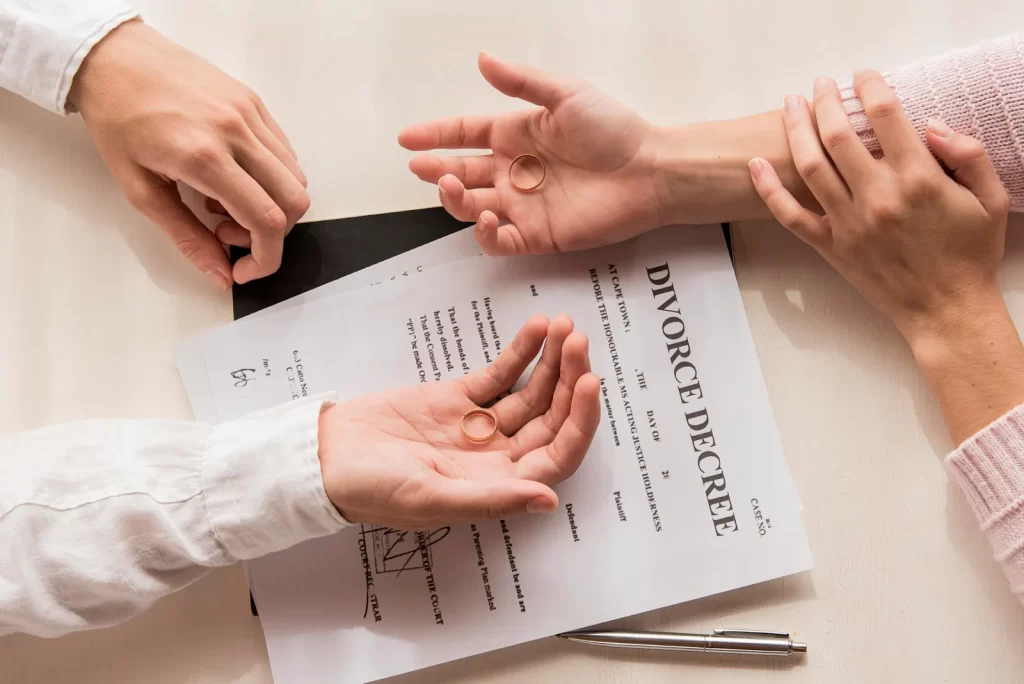
The divorce procedure in Singapore is intentionally structured into two distinct legal stages. This split helps the court deal with the question of ending the marriage separately from the practical matters that follow, such as finances and children.
Understanding this distinction allows couples to better manage expectations, timelines, and preparation. In simple terms, Stage 1 decides whether the marriage should end, while Stage 2 settles how both parties move forward after the marriage ends.
Stage 1: Dissolution of Marriage
This initial phase is entirely about proving to the court that the marriage has “irretrievably broken down.” You cannot simply “want” a divorce; you must prove it by citing one of the six specific “facts” recognized under the Women’s Charter.
- The 6 Facts to Prove Breakdown:
- Adultery: You must prove your spouse had voluntary sexual intercourse with a third party. Because direct proof is often difficult to obtain, many rely on confessions or private investigator reports.
- Unreasonable Behaviour: This is the most common fact used. It covers a wide range of conduct from physical or emotional abuse to financial irresponsibility or even a total lack of communication that makes it intolerable for you to continue living with your spouse.
- Desertion: Your spouse has abandoned you for a continuous period of at least two years without your consent and with no intention of returning.
- 3-Year Separation (With Consent): You and your spouse have lived separate lives (even if under the same roof) for three continuous years, and both of you agree to the divorce.
- 4-Year Separation (Without Consent): If you have lived apart for four years, you do not need your spouse’s consent to move forward.
- Divorce by Mutual Agreement (DMA): Introduced in July 2024, this allows couples to take joint responsibility for the breakdown without “blaming” one party, provided they submit a written agreement detailing their reasons and reconciliation efforts.
- The Initial Bundle of Documents: The process begins when the Plaintiff (the person filing) submits a bundle of documents to the court via the electronic filing system.
This bundle includes the Writ of Divorce, which is the formal “summons”; the Statement of Claim, which outlines the facts of the marriage; and the Statement of Particulars, a detailed document where you provide the specific evidence supporting your chosen ground (e.g., specific instances of unreasonable behaviour).
- Interim Judgment: If the court is satisfied that the marriage has indeed broken down, it will grant an Interim Judgment (IJ). It is important to understand that the IJ is a “provisional” order. While it officially recognises that the marriage is over, it is not yet final.
You are still technically married at this stage and cannot remarry. The IJ serves as the green light to proceed to Stage 2, where the “business” of the divorce is settled.
Stage 2: Ancillary Matters
In this second stage, the court addresses three primary areas: the division of matrimonial assets, financial maintenance, and the future of the children. Because the court aims for a fair outcome rather than a simple 50/50 split, the process is highly detailed and evidence-based.
- The Affidavit of Assets and Means (AOM): The bedrock of Stage 2 is the AOM. This is a sworn declaration where both you and your spouse must provide a “full and frank” disclosure of your entire financial life.
You are required to list all global assets not just those in Singapore including property, bank accounts, CPF savings, shares, and even jewellery or club memberships. You must also detail your monthly income and average expenses.- The Risk of Hiding Assets: If a party is found to be dishonest or vague, the court can draw an “adverse inference.” This means the judge may assume you have more wealth than you’ve declared and award a larger share of the known assets to your spouse as a result.
- Financial vs. Non-Financial Singapore law recognises that a marriage is an equal partnership of different efforts. To divide assets fairly, the court typically uses a structured “Broad-Brush” approach:
- Direct Financial Contributions: This includes the hard numbers on who paid the downpayment for the HDB, who serviced the mortgage, and how much CPF was utilised.
- Indirect Contributions: This is where the court acknowledges non-monetary efforts. It looks at who managed the household, cared for the children, or supported the other spouse’s career.
- The Ratio: The court often averages the ratio of direct and indirect contributions to reach a final percentage. In long marriages with children, the court tends to give significant weight to indirect contributions, acknowledging that the “homemaker” role is just as vital as the “breadwinner” role.
- Custody, Care and Control, and Access When it comes to children, the “Best Interests of the Child” is the only standard that matters. The court separates parenting into three distinct categories:
- Custody: This refers to major, long-term decisions regarding education, religion, and healthcare. In Singapore, Joint Custody is the default, as the court believes both parents should remain involved in these life-changing choices.
- Care and Control: This determines which parent the child will live with on a day-to-day basis. The parent with Care and Control handles the daily routine, such as meals and school runs.
- Access (Visitation): The parent who does not have Care and Control is granted “Access.” This can range from “Reasonable Access” (flexible and agreed upon by parents) to a “Scheduled Access” list that specifies exact times for weekends, public holidays, and school breaks.
The Final Step: Final Judgment
The transition from a “provisional” divorce to a “final” one is not automatic. It requires a specific application and the fulfillment of several legal conditions.
- The Mandatory 3-Month Waiting Period: By law, you must wait at least three months from the date your Interim Judgment was granted before you can apply for the Final Judgment.
This period serves as a “cooling-off” window, allowing a final opportunity for reconciliation should either party have a change of heart.
Furthermore, the court will only grant the Final Judgment once all ancillary matters (such as the division of assets and child custody) have been fully resolved and recorded as a final order. If your financial disputes are still ongoing, the clock effectively pauses until those matters are settled.
- Finalising the Case via LawNet & CrimsonLogic Service Bureau: If you are representing yourself, you must officially “extract” the Final Judgment. This is done through the LawNet & CrimsonLogic Service Bureau, which provides the electronic filing infrastructure for the Singapore courts.
- The Application: You will need to file a formal request (Form 12 under the current Practice Directions) to make the Interim Judgment final.
- The Review: Once submitted, the court registrar reviews the application to ensure the three-month period has passed and that all ancillary orders are in place.
- The Certificate: Upon approval, you will receive the Certificate of Final Judgment. This document is vital; you will need it for administrative tasks like updating your marital status with the ICA or applying for a marriage license in the future.
- Enforcing Ancillary Orders: The Final Judgment is also the trigger for executing the practical terms of your split. It is your responsibility to ensure that the court’s orders are carried out.
- HDB and Property: If the court has ordered the sale of your matrimonial home or the transfer of a flat share, you must now present the Final Judgment to HDB or your conveyancing lawyer to initiate the transaction.
- CPF Transfers: For any division of CPF monies, the Final Judgment must be submitted to the CPF Board. They will only process the transfer of funds from one spouse’s account to another once they have the sealed final order.
- Maintenance and Custody: This is also the point where child maintenance payments and the official “Care and Control” schedules for your children begin in earnest.
How Long Does The Divorce Procedure In Singapore Take?

One of the most common questions people ask is how long the divorce procedure in Singapore will actually take. The answer depends largely on which track the case falls under and how much cooperation exists between both parties.
While some divorces are resolved within months, others can take a year or longer, especially when disputes arise. Understanding the typical timelines can help you plan your finances, housing, and family arrangements with greater confidence.
For a smooth, uncontested divorce under the Simplified Track, the process is generally much quicker. Where both parties agree on the divorce and all ancillary matters, such as asset division and child arrangements, the case may be completed within four to six months.
This timeline assumes that documents are properly prepared, there are no disputes, and court requirements, such as the Mandatory Co-Parenting Programme where applicable, are met without delay. Because there is no need for a full trial or lengthy hearings, the court can move efficiently from the Interim Judgment to the Final Judgment.
In contrast, contested divorce cases often take significantly longer. Delays commonly arise during Stage 2 when ancillary matters are disputed. Issues such as uncovering and valuing matrimonial assets can be time-consuming, particularly if one party does not provide full disclosure.
The need for expert valuations, for example of property, businesses, or investments, can further extend timelines.
Disagreements over child custody or maintenance may also require mediation, multiple hearings, or court-appointed assessments, all of which add months to the process. As a result, contested cases frequently take 12 months or more to conclude.
There are limited circumstances where the court may allow a faster transition to the Certificate of Final Judgment. This may happen when all ancillary matters are resolved quickly after the Interim Judgment, or where there are no outstanding issues to be decided.
However, this is not automatic and depends on the court being satisfied that all requirements have been properly addressed. While divorce is rarely instant, understanding these timelines helps set realistic expectations and allows individuals to make informed plans for the next stage of their lives.
5 Common Mistakes To Avoid During The Divorce Procedure In Singapore

The divorce procedure in Singapore can feel overwhelming, especially when emotions are running high and major life decisions need to be made quickly. However, many problems that arise during divorce are not caused by the law itself, but by avoidable missteps taken early on.
From filing too soon to making decisions based on emotion rather than strategy, these mistakes can lead to delays, higher costs, and unfavourable outcomes.
Understanding these common pitfalls helps you approach the process more calmly, make informed choices, and protect your long-term interests as the case progresses.
1. Filing For Divorce Without Meeting Legal Eligibility Requirements
One of the most common mistakes is attempting to start the divorce procedure without confirming eligibility. In Singapore, most divorces require the marriage to be at least three years old unless special permission is granted by the court.
Filing prematurely can result in the case being dismissed, wasting time and money. Properly assessing jurisdiction, marriage duration, and legal grounds before filing is crucial to avoid unnecessary delays.
2. Moving Out Of The Matrimonial Home Too Prematurely
While tensions may be high, moving out of the family home without legal advice can be a strategic error. In Singapore, this could impact your claim for Care and Control of the children, as the court prioritizes stability and the “status quo” for minors.
If you leave and the children stay with your spouse, it may inadvertently signal that your spouse is the primary caregiver. Always consult a lawyer before packing your bags.
3. Hiding Assets Or Failing To Provide “Full And Frank” Disclosure

During the Ancillary Matters stage, both parties must file an Affidavit of Assets and Means. A common mistake is attempting to hide bank accounts, CPF monies, or overseas properties.
Singapore courts take a very dim view of this; if discovery reveals hidden assets, the court can draw an “adverse inference,” which often results in the court awarding a significantly larger share of the known assets to the other spouse as a penalty.
4. Misunderstanding Custody And Access Arrangements For Children
Many parents assume custody automatically means control over all decisions or equal time with the child. In reality, the divorce procedure in Singapore separates concepts such as care and control, custody, and access.
Misunderstanding these distinctions often leads to unrealistic expectations and prolonged disputes. Courts prioritise the child’s welfare, not parental preference, making informed decision-making essential.
5. Treating Divorce As Purely Emotional Rather Than Legal
Divorce is emotionally charged, but approaching it solely from an emotional standpoint often leads to poor decisions. Many parties make impulsive choices, send hostile messages, or refuse reasonable negotiations, which later become evidence in court.
The divorce procedure in Singapore is document-driven and fact-based. Emotional reactions can undermine credibility and weaken one’s legal position, particularly in matters involving children or asset division.
Conclusion About Divorce Process In Singapore
Throughout this journey, the court’s paramount consideration remains the welfare of any children involved. Prioritising your children’s needs over personal grievances is not just a moral choice but a legal expectation in Singapore.
Embracing mediation and seeking amicable settlements outside of the courtroom is almost always the better path for your family’s long-term emotional and financial health.
To navigate these complexities successfully, seeking qualified help from a lawyer specialised in Singapore family law is vital to ensure a “just and equitable” outcome.
If you find yourself needing concrete evidence to support your case, especially regarding matrimonial or commercial disputes, CatchCheating is here to assist.
As Singapore’s top private investigators, we have the capability to complete complex assignments, perform extended surveillance, and reveal hidden information that is otherwise unavailable.
Backed by over 30 years of experience and licensed by the PLRD (Police Licensing & Regulatory Department) of Singapore, our agency specialises in both local and overseas family and commercial cases.
Whether you need to uncover infidelity or investigate a business partner, our certified team provides the comprehensive intelligence and legal counsel support you need to take the next step in your personal or professional life.
If you are seeking the services of a focused, dedicated, and licensed private detective to get the hard evidence you need, contact CatchCheating Singapore for private investigators in Singapore.
Frequently Asked Questions About Divorce Process In Singapore
Does My HDB Flat Have To Be Sold If We Haven’t Reached The Minimum Occupation Period (MOP)?
If you have not met the 5-year MOP, you generally cannot sell the flat on the open market. In such cases, the flat may have to be returned to HDB at a compensation price, or one party may apply to retain it under specific eligibility schemes (like the Single Singapore Citizen Scheme if they are over 35).
Are Overseas Assets Included In The Division Of Matrimonial Property?
Yes. The Singapore court has the power to include global assets in the matrimonial pool, provided they were acquired during the marriage or transformed into matrimonial assets.
While the court may not issue orders directly against foreign property, they can adjust the split of local assets (like your HDB or CPF) to account for the value of those overseas holdings.
Do I Need To Attend Court In Person For An Uncontested Divorce?
In most simplified (uncontested) cases, the requirement for parties to attend the hearing is dispensed with. Your lawyer will file the necessary paperwork, and the judge will review it in chambers. You will typically only need to attend if the judge requires clarification on specific terms regarding children or assets.
Are CPF Monies Divided Automatically By The Court?
No. While CPF is a matrimonial asset, the court must specifically order a “CPF Transfer” or “CPF Charging Order” for the funds to be moved. The CPF Board will only execute these transfers once they receive a clear and final court order that complies with their internal regulations.